Water Wise
There's plenty of ways you can be water wise and save water around your home. Check out our tips to get you started.

Every drip, drop and splash counts
We're helping you to become water wise around your home and garden with our tips to save drips. Follow these tips to save water - and money along the way.
In the home
In the garden
Our ongoing water wise rules are simple:
Water restrictions
- Check for leaks using your water meter
Turn off all taps and take a water meter reading before you go to bed or while out of the house for the day. Before any water is used the next day or when you return, take another reading. If it has increased it’s likely you have a leaking pipe, tap or toilet cistern. - Fix dripping taps
Place a cup under each tap overnight or while you're out of the house for the day. If there's more than a dribble in each cup the next day or when you return, you'll need to replace the washer. - Look for leaking toilets
Put a few drops of food dye in the toilet cistern. If in 15 minutes your toilet bowl is anything but pearly white, you have a leak that could be costing you 100 litres per day.
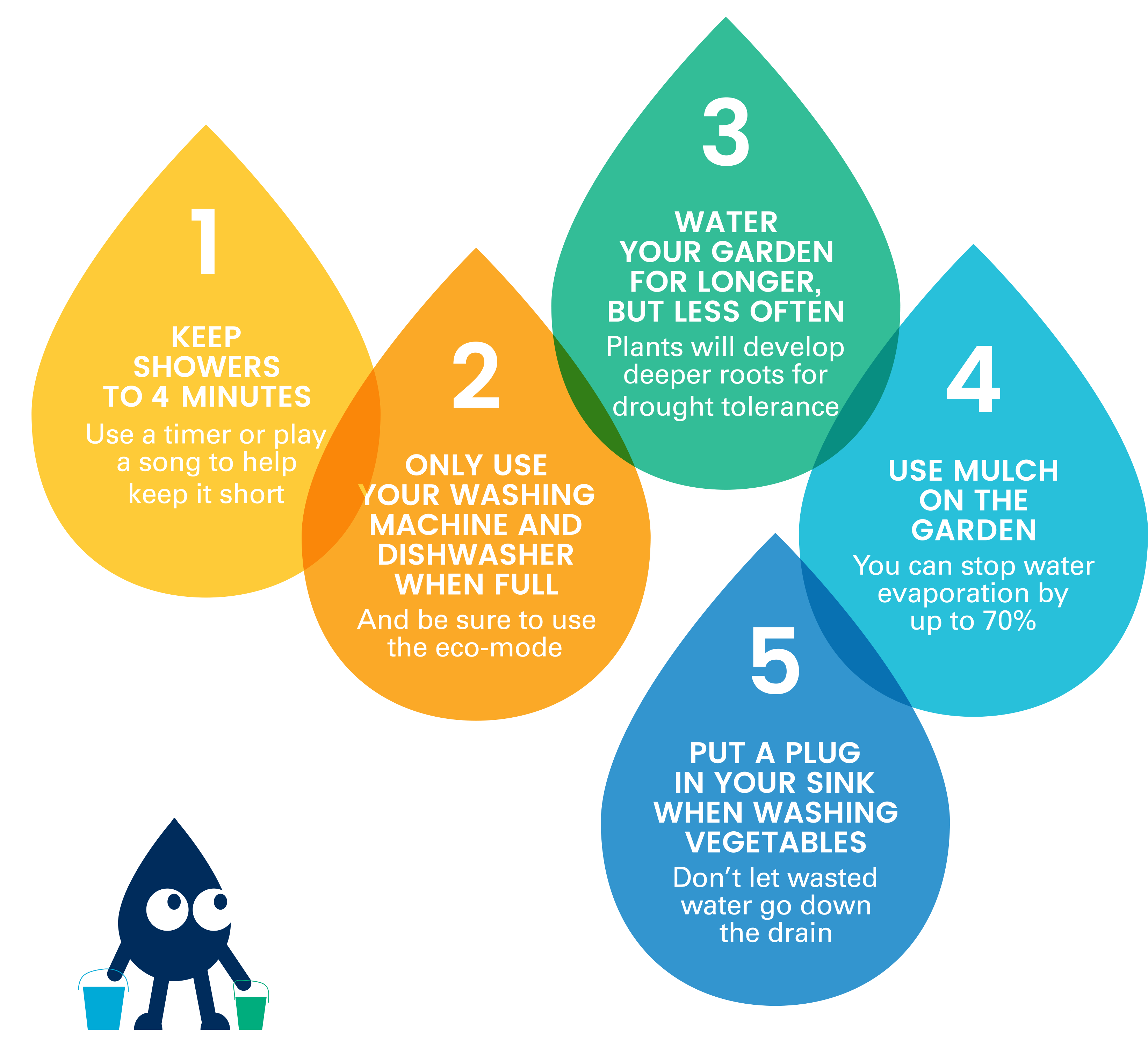
- Keep showers to 4 minutes
Use a timer or play a song to help keep it short. If you’ve got young kids, share a shower. - Use the half flush
If not, install a dual flush or place a brick in the cistern to reduce the amount of water used each flush. For a family of four, installing a dual flush toilet can save more than 35,000 litres per year. - Capture water from your tap
While waiting for water to warm up when running the shower, bath or sink, capture it in a tub. Use it to water your garden, indoor plants or wash the pets. - Install a water-efficient showerhead
Many showers use about 20 litres per minute, when 10 litres per minute is all you need. - Use a plug when shaving
Fill the sink with a little water instead of rinsing your razor under a running tap. - Turn off the tap when brushing your teeth
- Only use your washing machine when full and on eco mode
Save water and money. Every time you wash, it costs you around $1.00 in water, energy, detergent and machine wear. - Buy a water-efficient washing machine
Make sure it has at least a five-star water efficiency rating and four-star energy rating. Front loading washing machines are usually the most water-efficient, using up to 50% less water.
- Put a plug in your sink when washing vegetables, fruit or dishes by hand
Don't let wasted water go down the drain. - Only use your dishwasher when full and on eco mode
Every time you wash, it costs you around $1.00 in water, energy, detergent and machine wear. - Capture water from your tap
While waiting for water to warm up, capture it in a tub. Use it to water your garden, indoor plants or wash the pets. - Install aerating taps
These are inexpensive and can reduce water flow by 50 percent. - Buy new appliances thoughtfully
Be sure they have a high water conservation rating.
- Install a rainwater tank
Capturing rainwater to use in your garden is an excellent way to reduce the amount of water you use. Discuss your options with your local licensed plumber, who will also have to complete the installation. You can also read the Rainwater Tank Guidelines to learn more. - Use greywater
When safe and environmentally sustainable. You can read the Greywater Reuse Guidelines to learn more.
- Water your garden between 5pm and 10am
This minimises water evaporation. - Water your garden for longer but do it less often
This will encourage deeper roots which helps plants become more drought tolerant. - Use a broom to clean outdoor areas
Put the hose away and sweep driveways, paths and outdoor areas. - Use a trigger operated hose nozzle
That way you can effortlessly turn off the water between plants. - Set your mower to a higher level
A longer lawn needs less water, provides more shade for your soil and reduces evaporation. - Wash the car on the lawn
It's also a great idea to use a bucket and sponge, and rinse with a trigger operated hose nozzle.
- Use a pool cover
You'll reduce water evaporation from your pool by 40 to 90% depending upon the type of cover you use. - Consider other shade options
Such as shade sails and thoughtful planting. - Regularly check for pool leaks
- Use mulch on the garden
You can stop water evaporation by up to 70%. - Minimise lawn areas
They demand larger amounts of water. - Choose plants for a purpose
Group plants that demand large amounts of water together. Select native plants and shrubs that are indigenous to our local area and suitable for our climate. - Construct paved areas so that they slope
Sloped paved areas towards your lawn or garden areas to make use of water run off.
- Warm season grasses
Such as Couch have the lowest water demand. They also have a high drought tolerance. Other warm season grasses such as Buffalo and Kikuyu have a moderate water demand and are reasonably drought resistant. Cool climate grasses such as ryegrass, and bent grass have high water use rates and only a fair to poor drought resistance. Seek advice from a professional lawn care expert or your local nursery before deciding on a lawn type for your backyard. - Prepare your soil
Improved water efficiency can be achieved by adding a small amount of soil additive and organic matter, and rotary hoeing to a depth of 100 – 200mm. This encourages a deeper root systems and therefore a more efficient and resilient lawn. - Careful maintenance of your lawn is essential
Don’t over-water, particularly in the evening as this can lead to fungal problems in your plants. Look for signs of miss-watering, such as brown patches which indicate poor water distribution or areas that are not 'wettable' because of the soil type. Moss growing may indicate over-watering, poor drainage or insufficient sunlight reaching that area.